Your driveway gate does two jobs: it keeps your property secure and it’s the first thing anyone sees when they pull up. When you’re choosing between a sliding gate and a swinging gate for a Florida home, the decision depends on more than aesthetics. Lot shape, slope, HOA rules, and the coastal climate all factor in.
Here’s the honest breakdown — what each type does well, where each falls short, and how to decide which fits your driveway in Jacksonville, Nocatee, Ponte Vedra, or St. Johns.
How Each Gate Type Works
Sliding Gates
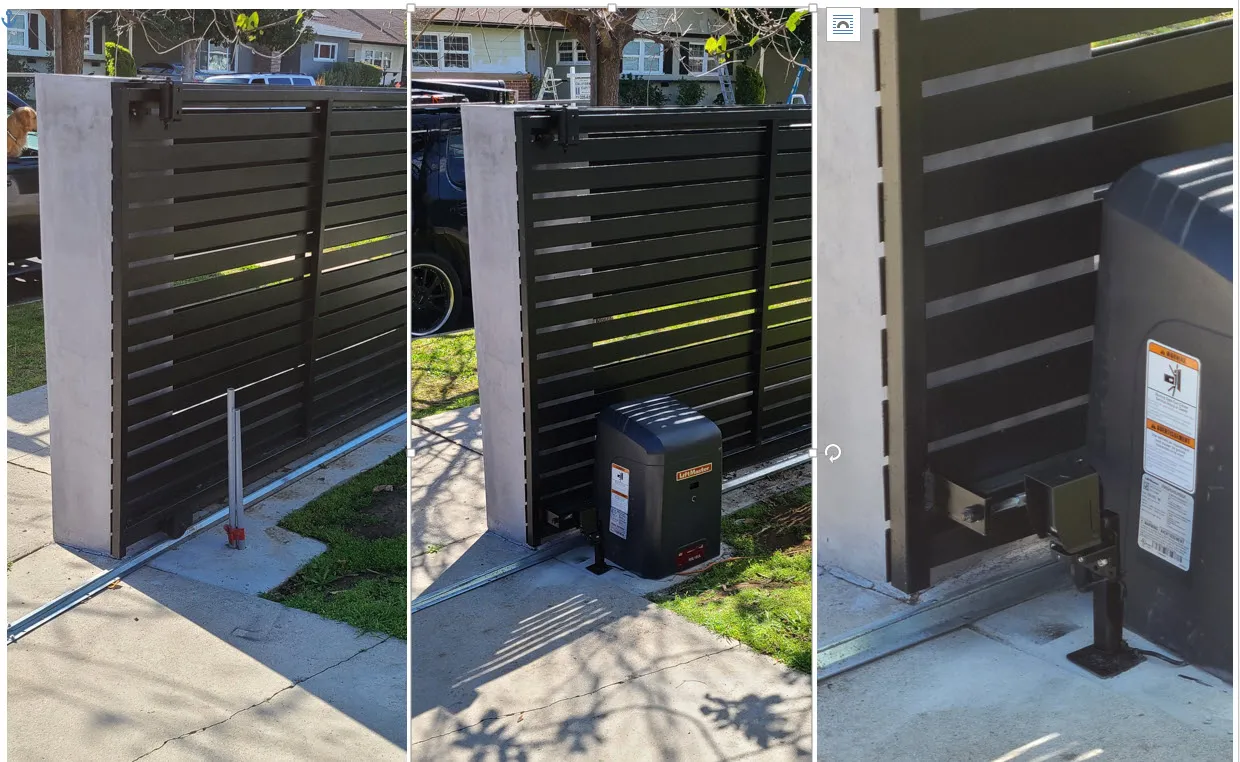
A sliding gate rolls horizontally along a track, moving parallel to the fence or wall. When open, it stacks to one side. When closed, it spans the full driveway opening. Most residential sliding gates use a cantilever design — they hang from a top-mounted track and don’t require a ground rail, which keeps the mechanism clean and avoids debris buildup.
Swinging Gates
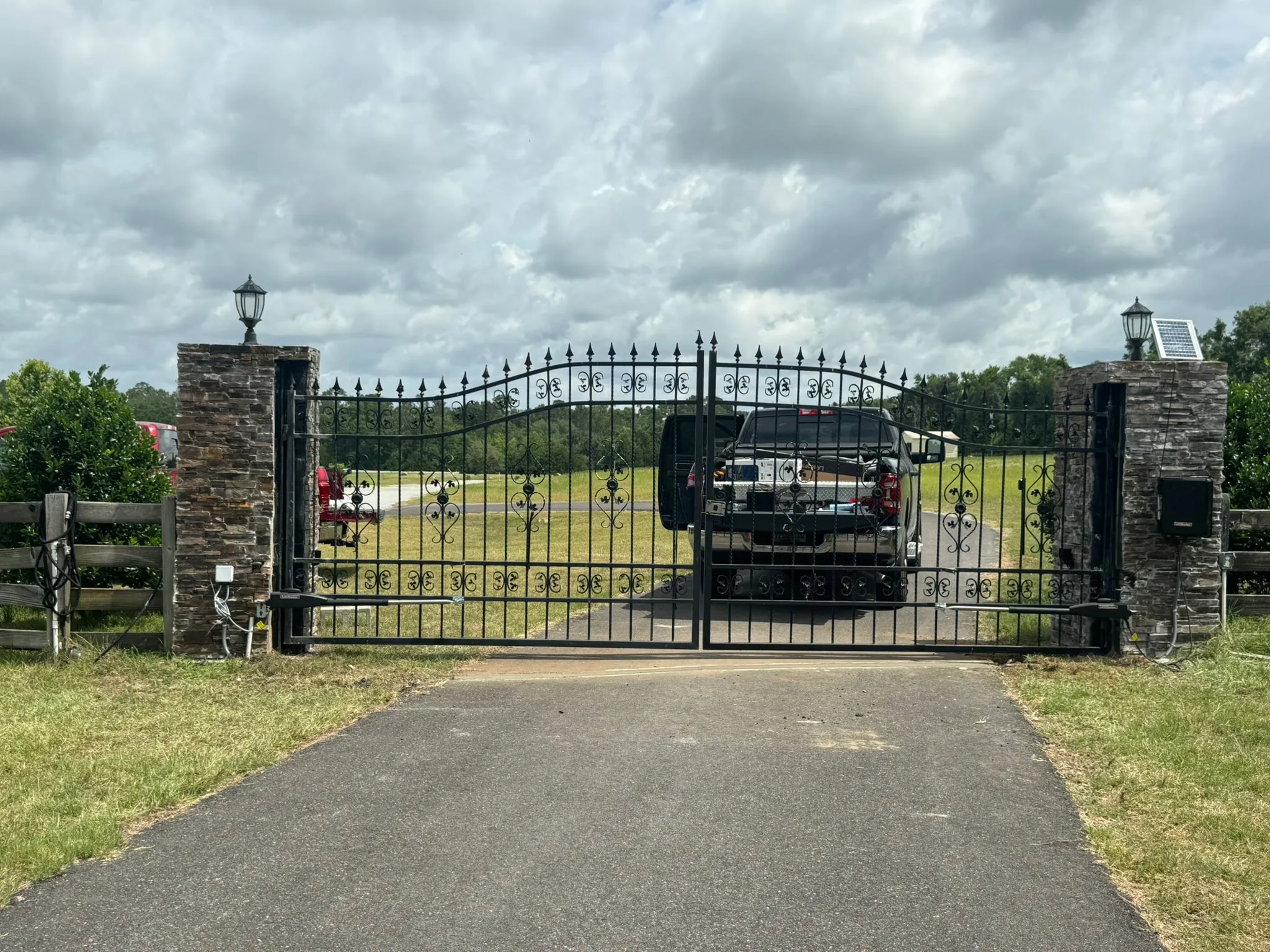
A swinging gate operates like a large door — it pivots on hinges mounted to a post or wall. Single-swing designs use one panel; bi-parting designs use two panels that meet in the middle. Swing-in gates open toward the property; swing-out gates open toward the street.
Which Fits Florida Better? 4 Key Factors
1. Lot Width and Clearance
This is often the deciding factor. A sliding gate needs clear space along one side of the driveway — typically 1.5× the opening width — for the gate to retract. A 12-foot driveway opening needs roughly 18 feet of clear fence line to park the gate when open.
Swinging gates need clearance in front of (or behind) the gate — the arc the panel sweeps through. A swing-in gate on a sloped driveway can bind against the ground partway through its arc. A swing-out gate can block traffic on the street or collide with a parked vehicle.
Verdict: Narrow lots with limited side clearance → sliding. Wide, flat driveways with no obstacles in the swing path → swinging works fine.
2. Sloped Driveways
Northeast Florida homes — especially in St. Johns and Nocatee — often sit on gently sloped lots where the driveway rises toward the garage. Swinging gates on slopes require careful measurement: the pivot point must be set so the bottom of the gate clears the pavement at the widest arc point. Get it wrong and the gate grinds or binds.
Sliding gates handle slopes better because they move parallel to the fence, not perpendicular to the driveway grade. The ground-level track (if used) is set into the pavement, not against it. Cantilever sliding gates eliminate the track entirely.
Verdict: Sloped driveway → sliding is more reliable long-term.
3. Florida Weather and Salt Air
Gates in Jacksonville face heat, humidity, tropical downpours, and — for coastal properties in Ponte Vedra and Atlantic Beach — salt-laden air that accelerates corrosion on hardware.
Sliding gates have more moving parts (rollers, track, cantilever brackets) that can corrode or seize if not maintained. Powder-coated aluminum or galvanized steel hardware is essential. The cantilever design avoids the ground-level track, which reduces corrosion risk significantly.
Swinging gates have simpler hinge mechanisms but hinges take the full weight of the panel every cycle. Over time, outdoor hinges on heavy wrought-iron or steel gates loosen and sag — a common repair call in coastal zip codes. Stainless or powder-coated hardware helps, but swing gates on heavy ornamental panels require periodic adjustment.
Verdict: Either works with the right materials. Cantilever sliding gates have a slight edge in salt-air environments because the mechanism is above ground.
4. HOA Restrictions in Jacksonville Communities
Many communities in Nocatee, Ponte Vedra Beach, and World Golf Village have gate style guidelines in their CC&Rs. Common restrictions include:
- Gate material (aluminum only, no chain link visible from street)
- Color (must match fence or home exterior)
- Height limits (typically 6 feet max in residential zones)
- Swing direction (swing-in only to avoid blocking sidewalks)
- Automation requirements (must have battery backup for emergencies)
Before ordering any gate, pull your HOA architectural guidelines. Some require pre-approval with a drawing and material sample. Lavish can help you spec a gate that will pass HOA review the first time — our gate installation team works with Jacksonville-area HOAs regularly.
Automation: Both Types Work
Both sliding and swinging gates can be automated with a motor and remote access. The drive mechanism is different — sliding gates use a rack-and-pinion or chain drive along the fence line, while swing gates use a linear actuator or articulating arm mounted to the post.
Key differences in automation cost:
- Sliding gate operators — typically $300–$600 for the motor alone; require a longer run of rack or chain hardware. More complex install on longer openings.
- Swing gate operators — typically $200–$450 per leaf. Bi-parting swing gates need two motors, doubling the equipment cost but keeping install time similar.
Both can integrate with keypads, intercoms, phone apps, and smart-home systems. LiftMaster and FAAC both make residential gate operators designed for Florida’s climate — Lavish installs and services both brands.
Cost Comparison in Jacksonville (2026)
| Sliding Gate | Swinging Gate | |
|---|---|---|
| Gate panel (aluminum, 12 ft) | $800–$1,800 | $600–$1,400 |
| Automation motor | $350–$600 | $250–$500 per leaf |
| Installation labor | $400–$700 | $300–$600 |
| Total (automated, installed) | $1,550–$3,100 | $1,150–$2,500 |
Sliding gates cost slightly more because of the additional track and bracket hardware, plus more complex installation. Swinging gates on heavy ornamental iron or with dual leaves can approach the same price.
Which Should You Choose?
Choose a sliding gate if:
- Your lot has limited side clearance for the panel arc
- Your driveway is sloped
- You want a clean, modern look (popular in contemporary and Florida-modern style homes)
- You have a wide opening (14+ feet) — sliding scales better
Choose a swinging gate if:
- You have ample clearance for the swing arc (flat lot, no obstacles)
- Your HOA specifies swing-in configuration
- You prefer traditional or ornamental ironwork styling
- Budget is the primary concern on a standard opening
Not sure which your property needs? Lavish offers free on-site consultations for gate projects in St. Johns, Nocatee, and across Jacksonville. We’ll measure your driveway, check the grade, and walk you through which option makes sense before you commit to anything. Call (904) 815-3310 or visit our gate installation page to get started.